new

Get trending papers in your email inbox!

Subscribe

Trending Papers

byAK and the research community

Trending Papers
Submitted by
janchorowski

BDH-CQ: In-Context Learning with Recurrent Latent Reasoning

A 150M-parameter reasoning model using recurrent latent reasoning and in-context learning achieves a new cost-accuracy frontier on ARC-AGI-1.

pathwaycom Pathway · Aug 10, 2026

TradingAgents: Multi-Agents LLM Financial Trading Framework

A multi-agent framework using large language models for stock trading simulates real-world trading firms, improving performance metrics like cumulative returns and Sharpe ratio.

  • 4 authors
· Dec 28, 2024
Submitted by
MatrAIx

MatrAIx: Simulating the World with 8.3 Billion Persona Agents

MatrAIx is a large-scale simulated-user evaluation framework that uses diverse persona records and interactive environments to test AI systems across many domains.
MatrAIx2026 MatrAIx · Aug 4, 2026
Submitted by
taesiri

Unlimited OCR Works

Unlimited OCR introduces Reference Sliding Window Attention to eliminate growing memory consumption during long-sequence OCR tasks, enabling efficient transcription of multiple pages in a single forward pass.

baidu BAIDU · Jun 22, 2026

Kronos: A Foundation Model for the Language of Financial Markets

Kronos, a specialized pre-training framework for financial K-line data, outperforms existing models in forecasting and synthetic data generation through a unique tokenizer and autoregressive pre-training on a large dataset.

  • 7 authors
· Aug 2, 2025
Submitted by
taesiri

JoyAI-Video-Edit: Real-Time Open-Ended Video Editing with Autoregressive Diffusion

JoyAI-Video-Edit is a 16B-parameter autoregressive diffusion framework that enables real-time, open-ended video editing with high source fidelity and long-term temporal consistency on a single GPU.

jingdong1 jingdong · Aug 4, 2026

HuggingFace's Transformers: State-of-the-art Natural Language Processing

Transformers library provides state-of-the-art Transformer architectures and pretrained models for natural language processing tasks with a unified API and emphasis on extensibility and robust deployment.

huggingface Hugging Face · Oct 9, 2019
Submitted by
akhaliq

OpenDevin: An Open Platform for AI Software Developers as Generalist Agents

OpenDevin is a platform for developing AI agents that interact with the world by writing code, using command lines, and browsing the web, with support for multiple agents and evaluation benchmarks.

  • 24 authors
· Jul 23, 2024
Submitted by
akhaliq

Efficient Memory Management for Large Language Model Serving with PagedAttention

PagedAttention algorithm and vLLM system enhance the throughput of large language models by efficiently managing memory and reducing waste in the key-value cache.

  • 9 authors
· Sep 12, 2023
Submitted by
taesiri

MinerU2.5: A Decoupled Vision-Language Model for Efficient High-Resolution Document Parsing

MinerU2.5, a 1.2B-parameter document parsing vision-language model, achieves state-of-the-art recognition accuracy with computational efficiency through a coarse-to-fine parsing strategy.

  • 61 authors
· Sep 26, 2025
Submitted by
unilm

VibeVoice Technical Report

VibeVoice synthesizes long-form multi-speaker speech using next-token diffusion and a highly efficient continuous speech tokenizer, achieving superior performance and fidelity.

MicrosoftResearch Microsoft Research · Aug 26, 2025
Submitted by
akhaliq

Mem0: Building Production-Ready AI Agents with Scalable Long-Term Memory

Mem0, a memory-centric architecture with graph-based memory, enhances long-term conversational coherence in LLMs by efficiently extracting, consolidating, and retrieving information, outperforming existing memory systems in terms of accuracy and computational efficiency.

  • 5 authors
· Apr 28, 2025

Multi-module GRPO: Composing Policy Gradients and Prompt Optimization for Language Model Programs

mmGRPO, a multi-module extension of GRPO, enhances accuracy in modular AI systems by optimizing LM calls and prompts across various tasks.

  • 13 authors
· Aug 6, 2025
Submitted by
taesiri

ABot-World-0: Infinite Interactive World Rollout on a Single Desktop GPU

ABot-World-0 is a real-time action-conditioned video world model that uses progressive distillation, long-horizon alignment, and a co-designed streaming stack to enable efficient, long-horizon interactive world generation.

acvlab Alibaba AMAP CV Lab · Jul 21, 2026
Submitted by
ChengCui

PaddleOCR-VL-1.6: Expanding the Frontier of Document Parsing with Under-Optimized Region Refinement and Progressive Post-Training

PaddleOCR-VL-1.6 enhances document parsing performance through targeted data optimization and progressive post-training techniques, achieving state-of-the-art results on OmniDocBench v1.6.

PaddlePaddle PaddlePaddle · Jun 2, 2026
Submitted by
razzant

Ouroboros: A Self-Developing Frontier Coding Agent with Reviewed Core Evolution

We present Ouroboros, a self-developing agent harness whose tools, prompts, context assembly, and core implementation improve through reviewed commits that become the runtime for later work. Core evolution proceeds in two modes. In recursive free evolution, improvement is itself a task, and completing one evolution cycle can schedule the next. In experience-driven core evolution, ordinary work and social interaction expose bugs, rough edges, and inefficient context construction that lead to reviewed structural changes. On Terminal-Bench 2.1, an Opus 5 run scores 86.74%, the best result reported on the benchmark. On OSWorld-Verified, an Opus 5 run reaches 90.69%, exceeding the best previously reported score. A five-rollout CL-Bench campaign achieves a normalized reward of 0.2301, setting a new state of the art. Hope is the longest-running publicly documented Ouroboros deployment. It is a 161-day living agent experiment in free evolution under governed human communication across seven surfaces. Human interaction surfaces faults and generates proposals, but the agent decides which changes to pursue. Because a self-developing agent may rewrite its own code and select new model APIs, operational safety becomes a primary design problem: guardrails must remain authoritative under evolutionary and public social pressure. Benchmark campaigns use frozen system snapshots, while Hope continues live evolution on a separate lineage.

  • 6 authors
· Aug 8, 2026
Submitted by
taesiri

Kimi K3: Open Frontier Intelligence

Kimi K3 is a large-scale mixture-of-experts model with native vision and long-context capabilities that improves scaling efficiency and achieves strong performance across coding, reasoning, and agentic tasks.

moonshotai Moonshot AI · Jul 27, 2026

IndexTTS: An Industrial-Level Controllable and Efficient Zero-Shot Text-To-Speech System

IndexTTS, an enhanced text-to-speech system combining XTTS and Tortoise models, offers improved naturalness, enhanced voice cloning, and controllable usage through hybrid character-pinyin modeling and optimized vector quantization.

  • 5 authors
· Feb 8, 2025
Submitted by
seashell11

LongHorizon-Harness: Advancing Long-Horizon Agents for Real-World Tasks

LongHorizon-Harness improves long-horizon agent performance by explicitly tracking verified task states outside context via a manage-execute-audit loop.

  • 8 authors
· Aug 3, 2026
Submitted by
andito

SmolDocling: An ultra-compact vision-language model for end-to-end multi-modal document conversion

SmolDocling is a compact vision-language model that performs end-to-end document conversion with robust performance across various document types using 256M parameters and a new markup format.

ibm-granite IBM Granite · Mar 14, 2025

Continuous Audio Language Models

Audio Language Models (ALM) have emerged as the dominant paradigm for speech and music generation by representing audio as sequences of discrete tokens. Yet, unlike text tokens, which are invertible, audio tokens are extracted from lossy codecs with a limited bitrate. As a consequence, increasing audio quality requires generating more tokens, which imposes a trade-off between fidelity and computational cost. We address this issue by studying Continuous Audio Language Models (CALM). These models instantiate a large Transformer backbone that produces a contextual embedding at every timestep. This sequential information then conditions an MLP that generates the next continuous frame of an audio VAE through consistency modeling. By avoiding lossy compression, CALM achieves higher quality at lower computational cost than their discrete counterpart. Experiments on speech and music demonstrate improved efficiency and fidelity over state-of-the-art discrete audio language models, facilitating lightweight, high-quality audio generation. Samples are available at https://continuous-audio-language-models.github.io

  • 5 authors
· Sep 8, 2025
Submitted by
RuofengYang

ARIS: Autonomous Research via Adversarial Multi-Agent Collaboration

ARIS is an open-source research harness that uses cross-model adversarial collaboration to ensure reliable long-term research outcomes through coordinated execution, orchestration, and assurance layers.

Submitted by
iseesaw

Frontis-MA1: Training an AI4AI Model towards Recursive Self-Improvement in Machine Learning Engineering

OpenMLE enables recursive self-improvement in machine learning engineering via a full-stack system combining execution-grounded operator learning and long-horizon evolutionary search, significantly boosting benchmark performance with a 35B model.

FrontisAI Frontis AI · Jul 30, 2026
Submitted by
nielsr

Ultralytics YOLO26: Unified Real-Time End-to-End Vision Models

YOLO26 addresses real-time vision challenges through a unified model family with NMS-free inference, improved training strategies, and multi-task capabilities spanning detection, segmentation, and pose estimation.

Ultralytics Ultralytics · Jun 2, 2026
Submitted by
taesiri

SkillOpt: Executive Strategy for Self-Evolving Agent Skills

SkillOpt introduces a systematic text-space optimizer for agent skills that trains skills as external agent state with stable updates and zero deployment inference overhead, achieving superior performance across multiple benchmarks and execution environments.

MicrosoftResearch Microsoft Research · May 22, 2026

Zep: A Temporal Knowledge Graph Architecture for Agent Memory

Zep, a memory layer service, outperforms MemGPT in the DMR benchmark and LongMemEval by excelling in dynamic knowledge integration and temporal reasoning, critical for enterprise use cases.

  • 5 authors
· Jan 20, 2025
Submitted by
taesiri

AgentScope 1.0: A Developer-Centric Framework for Building Agentic Applications

AgentScope enhances agentic applications by providing flexible tool-based interactions, unified interfaces, and advanced infrastructure based on the ReAct paradigm, supporting efficient and safe development and deployment.

  • 23 authors
· Aug 22, 2025
Submitted by
akhaliq

Very Large-Scale Multi-Agent Simulation in AgentScope

Enhancements to the AgentScope platform improve scalability, efficiency, and ease of use for large-scale multi-agent simulations through distributed mechanisms, flexible environments, and user-friendly tools.

  • 8 authors
· Jul 25, 2024

LightRAG: Simple and Fast Retrieval-Augmented Generation

LightRAG improves Retrieval-Augmented Generation by integrating graph structures for enhanced contextual awareness and efficient information retrieval, achieving better accuracy and response times.

  • 5 authors
· Oct 8, 2024
Submitted by
nielsr

Geometric Context Transformer for Streaming 3D Reconstruction

LingBot-Map is a feed-forward 3D foundation model that reconstructs scenes from video streams using a geometric context transformer architecture with specialized attention mechanisms for coordinate grounding, dense geometric cues, and long-range drift correction, achieving stable real-time performance at 20 FPS.

robbyant Robbyant · Apr 15, 2026

Native and Compact Structured Latents for 3D Generation

A new sparse voxel representation called O-Voxel enables high-quality 3D generative modeling with efficient inference and robust topology handling.

microsoft Microsoft · Dec 16, 2025
Submitted by
Paranioar

SenseNova-U1: Unifying Multimodal Understanding and Generation with NEO-unify Architecture

Unified vision-language models treat understanding and generation as integrated processes rather than separate tasks, demonstrating strong performance across multiple multimodal capabilities including image synthesis and action reasoning.

sensenova SenseNova · May 12, 2026
Submitted by
zbhpku

DataFlow: An LLM-Driven Framework for Unified Data Preparation and Workflow Automation in the Era of Data-Centric AI

DataFlow is an LLM-driven data preparation framework that enhances data quality and reproducibility for various tasks, improving LLM performance with automatically generated pipelines.

PekingUniversity Peking University · Dec 18, 2025

Bitnet.cpp: Efficient Edge Inference for Ternary LLMs

Bitnet.cpp enhances edge inference for ternary LLMs using a novel mixed-precision matrix multiplication library, achieving significant speed improvements over baselines.

  • 10 authors
· Feb 17, 2025
Submitted by
nielsr

MonkeyOCRv2: A Visual-Text Foundation Model for Document AI

MonkeyOCRv2 is a document-oriented visual-text pretrained encoder that improves performance across document analysis and multimodal document understanding tasks while using a much smaller vision backbone.

VLRLab-OCR VLRLab-OCR · Jul 13, 2026
Submitted by
MengqiLei

Count Anything

A generalist model for text-guided object counting across multiple domains is presented, utilizing dual-granularity instance enumeration and complementary counting fusion for improved accuracy and cross-domain generalization.

  • 7 authors
· May 29, 2026
Submitted by
akhaliq

LlamaFactory: Unified Efficient Fine-Tuning of 100+ Language Models

LlamaFactory is a unified framework enabling efficient fine-tuning of large language models across various tasks using a web-based user interface.

  • 5 authors
· Mar 20, 2024

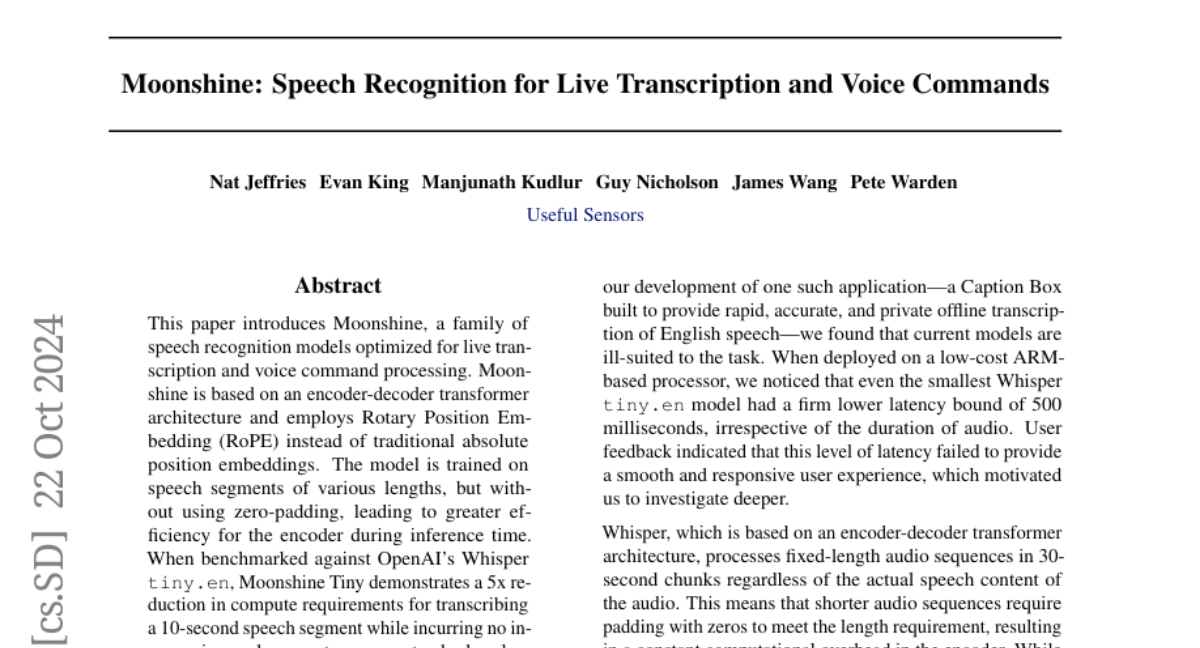
Moonshine: Speech Recognition for Live Transcription and Voice Commands

Moonshine, an encoder-decoder transformer architecture for speech recognition, uses Rotary Position Embedding, reducing compute requirements without decreasing accuracy.

  • 6 authors
· Oct 21, 2024
Submitted by
evanking

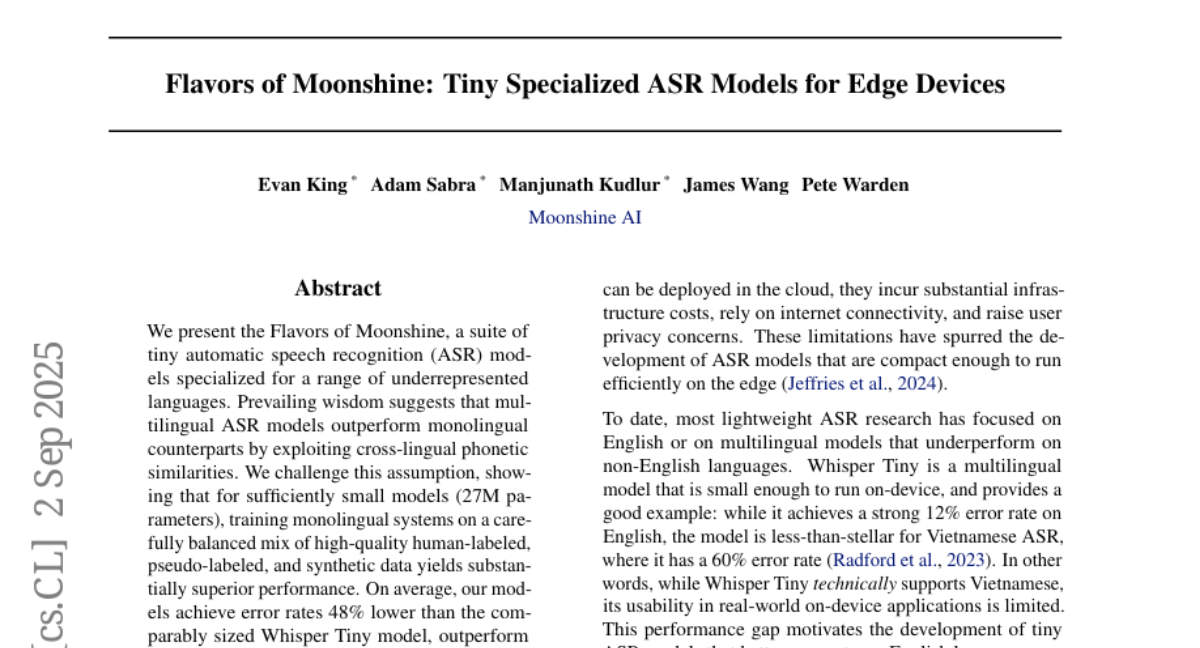
Flavors of Moonshine: Tiny Specialized ASR Models for Edge Devices

Monolingual ASR models trained on a balanced mix of high-quality, pseudo-labeled, and synthetic data outperform multilingual models for small model sizes, achieving superior error rates and enabling on-device ASR for underrepresented languages.

  • 5 authors
· Sep 2, 2025
Submitted by
andito

SmolVLA: A Vision-Language-Action Model for Affordable and Efficient Robotics

SmolVLA is a compact, efficient vision-language-action model that achieves competitive performance at reduced computational costs and can be deployed on consumer-grade hardware.

  • 14 authors
· Jun 2, 2025
Submitted by
taesiri

Hunyuan3D-Buffalo 1.0: A Unified Multimodal Model for Scalable 3D Generation, Understanding, and Editing

Hunyuan3D-Buffalo 1.0 unifies 3D understanding, generation, editing, and part generation via a multimodal architecture trained on a large-scale 3D corpus, achieving leading benchmark results.

Tencent-Hunyuan Tencent Hunyuan · Aug 3, 2026
Submitted by
Rbin

RAG-Anything: All-in-One RAG Framework

RAG-Anything is a unified framework that enhances multimodal knowledge retrieval by integrating cross-modal relationships and semantic matching, outperforming existing methods on complex benchmarks.

Submitted by
YeWen27

Xiaomi-Robotics-1: Scaling Vision-Language-Action Models with over 100K Hours of Real-World Trajectories

Xiaomi-Robotics-1 is a vision-language-action model trained on extensive real-world manipulation data that performs diverse mobile tasks in unseen settings and adapts efficiently to new tasks with minimal fine-tuning.

XiaomiRobotics Xiaomi Robotics · Jul 16, 2026
Submitted by
hao-li

Agent READMEs: An Empirical Study of Context Files for Agentic Coding

Agentic coding tools receive goals written in natural language as input, break them down into specific tasks, and write or execute the actual code with minimal human intervention. Central to this process are agent context files ("READMEs for agents") that provide persistent, project-level instructions. In this paper, we conduct the first large-scale empirical study of 2,303 agent context files from 1,925 repositories to characterize their structure, maintenance, and content. We find that these files are not static documentation but complex, difficult-to-read artifacts that evolve like configuration code, maintained through frequent, small additions. Our content analysis of 16 instruction types shows that developers prioritize functional context, such as build and run commands (62.3%), implementation details (69.9%), and architecture (67.7%). We also identify a significant gap: non-functional requirements like security (14.5%) and performance (14.5%) are rarely specified. These findings indicate that while developers use context files to make agents functional, they provide few guardrails to ensure that agent-written code is secure or performant, highlighting the need for improved tooling and practices.

  • 11 authors
· Nov 17, 2025
Submitted by
zeeshanp

Training Video Foundation Models with NVIDIA NeMo

A scalable open-source pipeline using NVIDIA NeMo for training and inference of Video Foundation Models addresses challenges in generating high-quality videos.

  • 29 authors
· Mar 17, 2025

AutoDev: Automated AI-Driven Development

AutoDev is an AI-driven software development framework that automates complex engineering tasks within a secure Docker environment, achieving high performance in code and test generation.

  • 5 authors
· Mar 13, 2024
Submitted by
akhaliq

h2oGPT: Democratizing Large Language Models

h2oGPT provides open-source, fine-tuned LLMs based on Generative Pretrained Transformers with 100% private document search capabilities.

  • 15 authors
· Jun 13, 2023

EverMemOS: A Self-Organizing Memory Operating System for Structured Long-Horizon Reasoning

EverMemOS presents a self-organizing memory system for large language models that processes dialogue streams into structured memory cells and scenes to enhance long-term interaction capabilities.

  • 11 authors
· Jan 5, 2026
Submitted by
FACEONG

N_0-TWAM: Scaling Tactile-Native World-Action Model for Contact-Rich Manipulation

N0-TWAM is a large-scale tactile-native world-action model that predicts future vision, contact, and actions for contact-rich manipulation using a unified force-based tactile representation, contact events for task staging, and an asymmetric mixture-of-transformers architecture.

NeoteAIEmbodied NeoteAI · Jul 26, 2026
Submitted by
taesiri

Fish Audio S2 Technical Report

Fish Audio S2 is an open-source text-to-speech system with multi-speaker capabilities, multi-turn generation, and instruction-following control through natural-language descriptions, utilizing a multi-stage training approach and production-ready inference engine.

fishaudio Fish Audio · Mar 9, 2026